Sunday, May 15, 2011

The Debate over Land-Based Salmon Farms

Currently, there is a very strong debate in British Columbia regarding land-based salmon farms: if this technology exists, why isn’t the industry adopting it?  On-land recirculation systems separate farmed salmon from the natural environment, thus removing any potentially harmful environmental effects that may stem from open net-cages.  Wastes from the farmed fish can be collected and treated rather than being released into the marine ecosystem.  Additionally, any diseases or parasites can be screened for and monitored much more closely, thus protecting both the farmed stock as well as the wild fauna.

However, there are several key points that must be addressed in this debate.  The first is that land-based systems are extremely expensive, both to build and to operate.  By their very nature, a land-based recirculation system is much more capital-intensive to set up than a net-pen operation: tanks, pipes, pumps, filters, the land itself, a building if necessary...these are all costs that net-pen operations do not have to cope with.  Add into the equation the cost of electricity and the overall carbon footprint of the facility, and suddenly land-based systems are not looking as attractive.

There is a fantastic report by Fisheries and Oceans Canada (2010) that states that while land-based recirculation systems may be economically viable, their high operating costs make them extremely sensitive to fluctuations in market conditions (the price of salmon, the price of electricity/water, etc.): the margins are so small that a tiny shift in the market may be all that is necessary for the system to lose its profitability.


While it may not be possible for the salmon industry in BC to adopt these systems immediately, there is hope on the horizon.  As I write this, researchers and engineers are working hard to continue developing these technologies with the sole purpose of increasing efficiency and decreasing operating costs.  Additionally, by implementing other sustainable farming methods (aquaponics, solar/wind power, etc.) the operating costs can be reduced even further. 

It is my opinion that these systems are inherently better than the current practices, but unfortunately we are simply not yet prepared to adopt them. 

Thursday, May 12, 2011

Aquaponics Makes a Splash at TED Talks

A few weeks ago, a staff member from the Institute of Aquaculture gave a fantastic presentation on aquaponics at an independently-organized ‘TED’ event in England.  As you may know, TED events consist of short 20-minute seminars given by experts in a number of fields, but presented in a way so as to be accessible and understandable to everyone.  Businesspeople, scientists, artists, you name it...every speaker has an innovative topic and the presentations are always interesting!

Charlie Price is one of the founding members of Aquaponics UK, a social enterprise that works as a consulting firm for aquaponics projects around the globe.  Before deciding to do my MSc dissertation on aquaculture insurance, I was in talks with Charlie to join his team for my dissertation work!

Charlie’s TED Talk covers the basics of aquaponics and explains how a well-designed system operates exactly like a natural ecosystem, with the wastes being recycled and used by other organisms.  He then walks through a facility that his company designed and built in London- fish, chickens, plants, and even flies are all cultivated together in a harmonious environment that people can actually visit and learn more about! 

Aquaponics is a reliable and versatile way to significantly reduce the impacts that aquaculture has on the environment.  And as Charlie describes, as you include more species in the system, it becomes cleaner, more productive, more efficient, and ultimately more profitable!

Charlie’s TED Talk can be viewed here: http://www.youtube.com/watch?v=7nIL9hWW3-Q

For more information about TED Conferences, or to watch TED Talks, please visit: http://www.ted.com/

Aquaculture Insurance MSc Dissertation

My MSc dissertation focuses on aquaculture stock mortality insurance in the United Kingdom and Ireland, working to identify the attitudes and perceptions that fish farmers have regarding this specialized product.  This study will provide a bridge between fish farmers and insurance companies to identify the accessibility and appropriateness of currently available stock mortality insurance policies.  It is expected that the conclusions of this study will help increase the suitability and value of future stock mortality products.


There is a short on-line questionnaire to be completed by fish farmers: it will take less than 15 minutes to fill out.  The questionnaire is available at the following website:


Saturday, April 23, 2011

Barcelona Fish Market

A vendor stands next to 10-kilo bags of rope-farmed mussels

While on holiday in Barcelona last week, I had the opportunity to go to the Barcelona Fish Market (Merca-Barna), a massive warehouse where fish is sold wholesale to distributors and retailers.  The market can move over 90 tonnes of fish per day, constantly working to satisfy the voracious demand for fish in this Mediterranean city.

Fishermen sell their catches to wholesalers, who then bring the fish into the market to sell to shop owners, restaurants, and local fish markets.  The variety of fish available was absolutely incredible: from mussels to tuna, shrimp to salmon, sea bream to monkfish...every type of fish you could possibly want!

The friend I was staying with in Barcelona use to work at the market as a health control officer, so he was friends with several of the vendors, allowing us to speak with them about the fish they were selling.  Some fish was wild-caught (the yellowfin tuna, for example), but much of it was farmed (mussels, salmon, sea bream, etc.).

In the end, we made a few purchases ourselves: 1 kilo of red shrimp (or gambas roja in Spanish), a 2-kilo salmon, 5 kilos of sea bream, 3 kilos of razor clams, a 5-kilo bag of mussels, and a gorgeous 3-kilo yellowfin tuna loin.

Overall, it was an amazing experience to see fish exchange on such a massive scale, especially given my interest in the economics of farmed seafood!
Merca-Barna in full swing

Yellowfin tuna loins for sale

Red shrimp

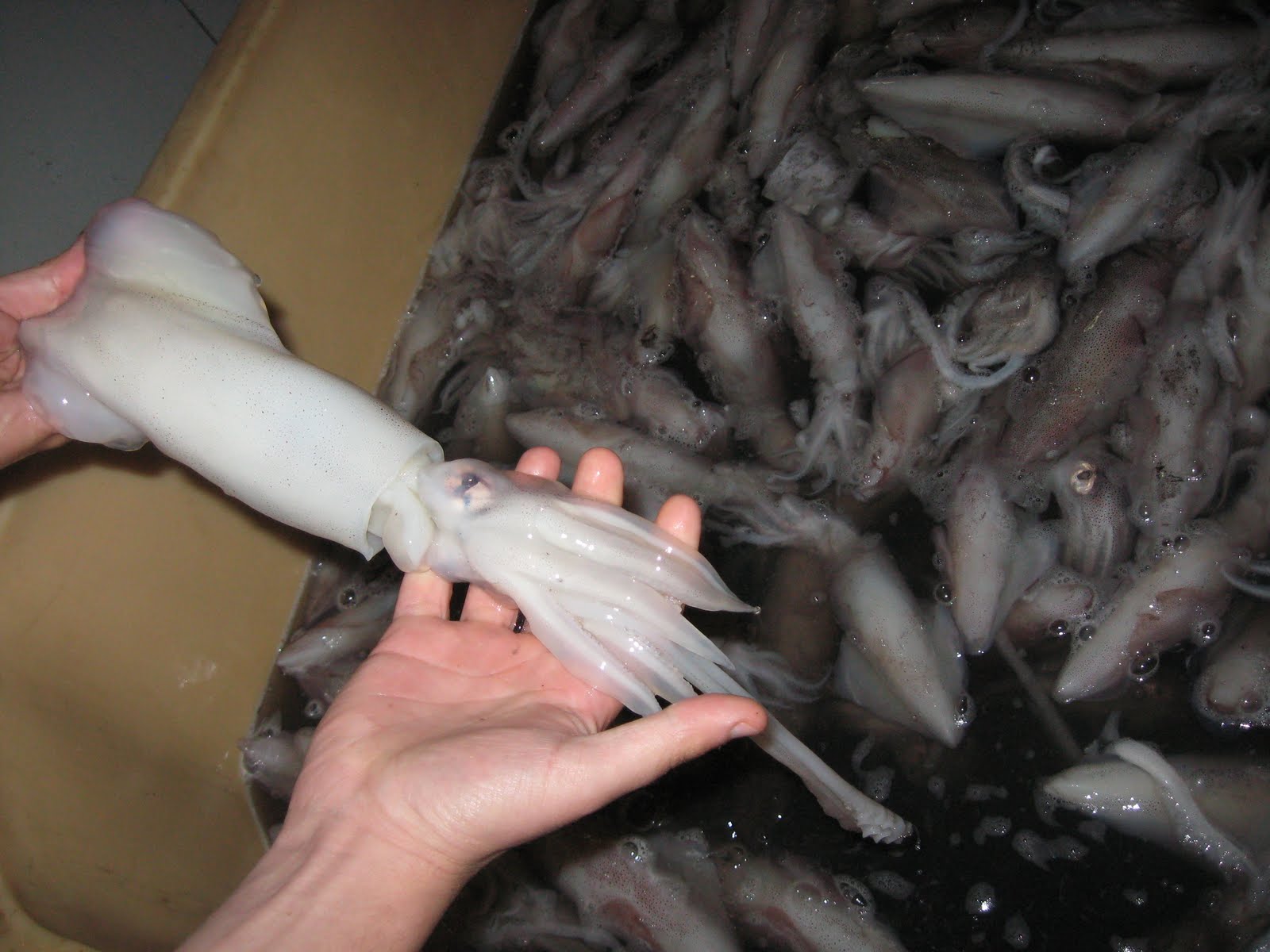
Squid


Saturday, April 9, 2011

Fish Farm Tour of Ireland- April 2011

After the Aquaculture Insurance Conference in Kinsale, Ireland, I spent several days touring fish farms in the south-west region of the country.  My father had flown out from Los Angeles to attend the Conference, so I joined him and several other delegates on these tours.  The entire trip was organized by Geoff Robinson, an Aquaculture Development Coordinator for the Irish Sea Fisheries Board (Board Ischa Maera).

We began at a sea urchin recirculation facility in Bantry Bay, where the farmers are growing urchins to sell their roe in French and Asian markets.  The roe, called 'uni' in sushi restaurants, is a highly-prized delicacy in certain countries, and the farmer was kind enough to allow us a small taste of urchins fresh from his tanks.  After that, we traveled by boat to a longline site, where a farmer was growing urchins and scallops: on this short visit we spoke about the life cycles and different production systems of these species.

Juvenile urchins
The orange masses are the roe, sold as 'uni' in sushi restaurants
A scallop farmer checks on his stock 


The next day we visited a recirculation system for abalone, a very valuable gastropod that resembles a large snail.  These animals can sell for up to 100 dollars per kilo, making their farming a potentially very profitable business.  The farmer had carefully planned the operation, from its design to its management, and overall the facility was very impressive.  After that, we drove to a salmon cage site (Murphy`s Irish Seafood), and while we did not have a chance to take the boat out to the cages, we spoke to the manager about the operation.  He informed us that the majority of salmon production in Ireland was organic and was marketed as such, allowing Irish salmon to be differentiated as a premium product in the marketplace.


The third day found us traveling from Bantry, where we had been staying for the past three nights, to Dublin, where we ended our tour.  Along the way, we stopped at a flow-through trout farm (Goatsbridge Premium Irish Trout), where rainbow trout were grown in earthen ponds.  This was a family-owned and -operated farm, with a hatchery, grow-out, and processing facilities on-site.  They had begun marketing hot-smoked trout fillets, which we tasted and found to be absolutely delicious.  They have experienced success with this product in the market, and plan to ramp up production to meet growing demand.
Goatsbridge Premium Irish Trout Farm- Thomastown, Ireland
All in all, the tour was a resounding success, as we had the opportunity to meet and speak with many different farmers operating many different production systems.  Additionally, these farmers will be the first ones that I contact with respect to my upcoming Master`s thesis project.    
Longlines used to grow urchins and scallops
The smoked trout was delicious!