Tuesday, August 14, 2012

New Technology Helps Predict Harmful Algal Blooms


Algal blooms are explosions of algae populations that occur naturally when the optimal conditions for that species is reached. While some algae blooms are harmless, others are toxic to fish and humans; these are known as Harmful Algal Blooms (HABs).  According to NOAA, " every year, harmful algal blooms cause approximately $82 million in damages to commercial fisheries and aquaculture, public health, and the recreation and tourism industries around the country, yet we don't have reliable ways to forecast and predict when they will occur" (http://www.nmfs.noaa.gov/aquaculture/homepage_stories/08_08_12aquaculture_esp.html)

However, a new piece of equipment developed by NOAA scientists may help predict harmful algal blooms before they occur.  The Environmental Sample Processor – or ESP for short – collects daily water samples and uses DNA probe technology to identify the presence of species that cause harmful algal blooms.  By receiving a warning that harmful populations of algae are increasing, fishermen and farmers are given more lead-time to prepare their sites or even change their harvest plans to avoid the bloom entirely.

By establishing a network of these ESPs, NOAA will be able to monitor large areas of water in real-time, communicating this information to the industry players whose livelihoods depend on the ocean. When combined with weather forecasts of optimal bloom conditions, this technology has the potential to save the US seafood industry millions of dollars annually.

The NOAA press release is available here: http://www.nmfs.noaa.gov/aquaculture/homepage_stories/08_08_12aquaculture_esp.html        

Friday, May 18, 2012

Sustainable Snails- Abalone Aquaculture in California


Abalone are large marine snails that are prized for their sweet, rich meat and striking mother-of-pearl shells.  Older residents of California will remember a time when abalone in the coastal waters were plentiful; overfishing coupled with extremely slow natural growth caused a collapse in the population, resulting in an end to the commercial harvest in the 1990's.  There is still a limited and tightly-regulated recreational harvest of abalone in California, but for the most part abalone has transformed from a common coastal dish into a rare, high-priced delicacy.


Demand for abalone is largest in Asia, where it is regarded culturally as a dish of significance, often served at weddings and special events.  Given that it takes up to 5 years for an abalone to reach the traditional market size (~100 grams), supply from wild stocks have not been able to keep up with demand.  Therefore, as with many overfished marine species before it, efforts began shifting from wild harvest to farming operations.

There are currently a handful of abalone farms in California producing a number of native species: these farms use cages, barrels, and/or tanks to spawn and rear abalone for eventual human consumption.  Abalone at these facilities are fed kelp that is harvested from the ocean by special kelp-cutting boats; this kelp is the natural food of abalone in the wild and due to its quick growth and tightly-regulated harvest, no negative impacts on kelp have been seen in 100 years of harvest.


Because the abalone grow so slowly and are fed a natural diet, the water leaving the abalone farms does not accumulate the same levels of nutrients and wastes as other aquaculture operations, making abalone farming a sustainable endeavor.  In fact, U.S. farmed abalone has received a green ranking (the highest possible) from the Monterey Bay Aquarium's Seafood Watch program.


While abalone is certainly not a food for the masses, those who are lucky enough to enjoy it will testify to its incredible flavor and texture, its amazing health properties, and the stunning beauty of its shell.  Wild populations of these amazing creatures are not expected to recover in California and as such we must remain committed to the development and propagation of this sustainable sector of aquaculture.


Tuesday, April 24, 2012

Want Salmon? How About a More Sustainable Choice Instead…


In BC, the environmental lobbyist’s push is towards on-land, closed loop, recirculation systems.  

Certain fish such as Arctic char, a member of the salmonid family, are produced in these recirc systems, often times domestically.  THIS is a fish you should be eating!  It is healthy (contains the same omega-3 compounds as salmon) with a mild flavor.  By purchasing char instead of salmon, you have the opportunity to directly support recirculation systems rather than environmentally-questionable farming practices OR unsustainable wild fishing quotas. 

Another example is trout, ANOTHER member of the salmonid family.  Trout are farmed in the US using flow-through systems: these systems dilute the wastes and minimize the environmental impact of the farm.  Like all fish, trout is low fat and high protein, and the taste of the meat is distinct (some people think it is too fishy).  By purchasing trout instead of salmon, you again directly support a more eco-friendly farming practice rather than industrial monoculture or unrealistic wild harvests.

Both char and trout have comparable nutritional values to salmon. 

I say put your money where your mouth is: if you want sustainable seafood, rather than farmed Atlantic salmon OR wild Pacific salmon, go out and buy char (my personal favorite) or trout.  Expand your diet for the good of the planet!  You never know…you might just like it!  

Wednesday, March 28, 2012

Commodity vs. Niche Markets and the Debate over Salmon in Recirc

In my opinion, there are two major markets for any food product: a commodity market and a niche market.  The overwhelming majority of food is sold on a commodity basis where consumers purchase products based on only one criterion: price.  These consumers do not care how the food was produced or where it came from: their only concern is the buying power of their dollar.  In contrast, niche markets comprise a much smaller portion of the total marketplace; consumers searching for niche products will concern themselves with factors other than price when selecting a product.  These consumers will ask how the food was produced and where it came from, and the decision to purchase will only occur once the consumers’ sense of ethics and quality are satisfied.  The important point here is that niche consumers are less concerned with price and would be willing to pay premium prices for what they value as premium products.

Like any other food, we can apply this model to farmed Atlantic salmon, which is very much a commodity product: it is comparable in price to terrestrial meats such as beef and poultry, and many consumers around the world are not concerned as to where the salmon came from or how it was produced.  When purchasing farmed Atlantic salmon, most consumers select based on price and move on…

Growing salmon in on-land recirculation systems has been hotly debated recently, and several projects are currently underway to test the business viability of such a practice.  However, by its very nature, recirculation systems are expensive to build and maintain, indicating that the species produced will need to be sold for a higher price. Higher prices can only be achieved in niche markets, and when coupled with the lowered environmental impact of recirculation systems, it would make sense for products grown in recirc systems to be destined for niche markets.

Now we have arrived at the challenge: if salmon is a commodity product, how can it be grown in recirculation systems and still be a commodity that is accessible to consumers who only want low prices?  Once the salmon is grown in recirc systems, it must transform from a commodity product into a niche product to allow the farmer to recover his capital and operating costs.  Therefore, salmon grown in recirc systems is going to be inherently more expensive than salmon grown in net pens: this is fine if the farmer is actively looking to target these niche markets.  For example, Irish salmon has done a fantastic job at differentiating on the basis of ‘organic’, and consumers are paying a premium price for this niche product.

Many people mistakenly believe that if we take net-pens out of the ocean and begin farming salmon on-land, the price and availability of farmed salmon will not change.  However, this is far from the expected outcome: by moving salmon farms on-land, the dynamics that currently dictate salmon markets will shift and a significant portion of the commodity market will be lost. 

Until such time as the capital and operating costs of recirculation systems become more manageable, farmed Atlantic salmon will continue to be a commodity product produced in net pens.  Rather than campaigning to remove net pens, we should be working together to tackle the challenges head-on and reform the industry for the benefit of future generations.  

Monday, March 26, 2012

‘Salmon’ Farming vs. ‘Fish’ Farming

Sometimes it is frustrating to work in the aquaculture industry.  There is so much misinformation and public scare-mongering emanating from environmental lobby groups that when I tell people that I work in aquaculture, most people turn up their noses and politely inform me that I shouldn’t spend my time destroying the planet.  I want to clear the air on one simple, vet vital, distinction that must be considered when discussing the activity’s environmental effects.

I live in British Columbia, and in BC when people say ‘fish farming’, in most instances they really mean to say ‘open-net salmon farming’.  Many “informed consumers” often confuse the two, saying one thing and intending another.  I saw a bumper sticker the other day that said ‘Friends Don’t Let Friends Eat Farmed Fish’.  I’ve got news for you: over half the seafood consumed globally is farmed, much of it in a more sustainable manner than current commercial salmon production.  In fact, salmon represents only 2% of global aquaculture production- in contrast, the majority of global aquaculture focuses on vegetarian finfish such as carps (which have feed-conversion ratios of less than 1) as well as shellfish which require no feed inputs.  By using the shortcomings of the salmon industry to vilify aquaculture as a global practice, environmental lobbyists are doing nothing more than openly displaying their ignorance.     

I have done the research and I will be the first one to stand up and point out the challenges associated with the sustainability (or rather lack thereof) of commercial salmon production.  Yet I stand flabbergasted every time someone on the street attempts to tell me that ‘fish farming is bad’ and that I should sign a petition to ‘make Canada a fish farm-free country’.  Aquaculture as a global practice has grown and developed to the point at which a huge variety of species are cultured in a range of production systems in almost every country around the world: to generalize the industry into one lump activity is not only plain wrong, it is dangerous.

Going forward I will continue to focus on awareness, open dialogue, and transparency as this industry continues to mature.  I hope that in time, consumers may yet better understand the issues associated with where their seafood comes from and make informed decisions about which aquaculture practices to support. 

Saturday, March 24, 2012

Aquaculture America 2012: Las Vegas

A few weeks ago I had the opportunity to attend the Aquaculture America 2012 conference, held this year in Las Vegas, Nevada.  The event attracted a wide audience from the US aquaculture industry, as well as many international manufacturers and producers.  The trade show featured hundreds of vendors from around the world, highlighting the latest advances and developments in design and research.


Having previously been to neither a large-scale aquaculture conference nor Las Vegas, I was understandably excited for the trip.  I arrived the evening before the Conference and had the opportunity to walk along the Strip and take it all in.  Yet once the conference started, my focus shifted entirely to my purpose for being there: listening, learning, and networking. 

The sessions covered a broad range of topics, from feed and genetics to economics and regulations.  The presenters themselves were just as varied, with members of government, education, and private sectors all in attendance. 

I had the opportunity to see some familiar faces as well as make many new contacts.  Given the breadth of people and industries in attendance, I feel as if I was successful in casting a wide net in terms of the individuals I met and the discussions I shared.  I am particularly excited about one or two of the people I met and the projects we discussed, which hopefully will be the basis of future articles for this blog. 

Overall I would say that it was time very well spent and I am already looking forward to Aquaculture America 2013 in Nashville next year!   

Tuesday, March 20, 2012

Returning to this Blog with a Bit More Gusto…

I write this after more than 5 months without putting pen to paper (so to speak) with this blog…

A lot has changed in 5 months.  After finishing the MSc., I returned to Vancouver where I secured a position with the AquaBioTech Group, an international aquaculture and environmental consulting network based in Malta.  The company specializes in the design and construction of recirculation systems, as well as marine surveying, market intelligence, research and development, and specialist audits, including environmental and risk management.  

I set up shop in Vancouver and am currently working as an aquaculture consultant and Regional Manager Canada for ABT, occupying my time with a variety of aquaculture-related activities and ventures.  While I won’t say too much at this point, what I can say is that there are some really cool things in the works, so check back to this blog often for updates and developments.

As I come back to this blog with a bit more gusto than as of late, I wanted to take an opportunity to thank those of you who have followed the blog over the years.  I get the occasional email from someone who has stumbled across an article that interests them, and I always enjoying hearing from readers.  As those who have contacted me will attest to, I am happy to share information and point people in the direction of further resources, so do not hesitate to be in contact.

I also wanted to share with you my plans for the future development of this blog.  While I will continue to write articles about my experiences in the industry, I also intend to write more opinion pieces, discussing important (and often misunderstood!) aspects of sustainability as it relates to fish farming around the world.  Perhaps more importantly, I will work to provide context and a ‘big picture’ perspective to these issues, hopefully enough so that you are inspired to do more research and form your own opinions.  I encourage people to post comments and foster constructive dialogue that focuses on solutions, not problems.

I am already looking forward to the next piece I am going to write, and I am not even sure what the topic is yet…  

Wednesday, November 9, 2011

'No ISA in BC' Says Canadian Government

On November 8, the Canadian Food Inspection Agency (CFIA), the Department of Fisheries and Oceans Canada (DFO), and the Province of British Columbia held a press conference to report that they had conducted a full investigation, reviewing both the samples and the initial reports, and that they found no consistent positive result indicating the presence of Infectious Salmon Anemia (ISA) in wild pacific salmon.

The best article I could have written wouldn't compare half as well to this article by John Fiorillo at Intrafish.com...

Enjoy!

ISA in Pacific salmon: Just kidding - First in Seafood News - Intrafish.com

Thursday, November 3, 2011

No Conclusive Evidence in ISA Scare

Today, IntraFish Media reported that there was no conclusive evidence to support the results of a previous test that found the Infectious Salmon Anemia (ISA) virus in wild BC salmon.  An ISA expert at the University of Bergen in Norway apparently retested the samples and was unable to reproduce the results of the original testing.

The Canadian Food Inspection Agency (CIFA) is the lead agency on this situation and has been developing their own tests and conclusions to verify or reject the presence of this virus.  I firmly believe it is important that people in the general public do not jump to conclusions and allow all the facts in this case to surface before taking any action.

Thursday, October 27, 2011

Virus Reported in Wild BC Salmon- Fact or Fiction?

A potentially lethal virus known as 'Infectious Salmon Amenia' (or 'ISA' for short) has been reported to be found in wild Pacific salmon on the northern coast of British Columbia, Canada.  Up until now, ISA has only been found in Atlantic salmon, which is a different species than any of the 5 species of fish that make up the group 'Pacific' salmon.  Therefore, if found to be accurate, this test would represent the first time this virus has been found in a new species of fish.

There are several factors to this scenario that demand pause and closer inspection before we run through the streets touting the end of salmon as we in BC know it.  First off, the test used to identify the virus is extremely sensitive and prone to results of false-positives.  Next, only 2 samples in 48 tested positive, which warrants further testing even in the best of circumstances.  However, the lab claims that the samples were all used up in the testing, and that repeating the testing is now not possible.  Any run-of-the-mill scientist will tell you that in order to preserve scientific accuracy, you never use all the sample for testing because the results of any test must be able to be reproduced- that is one of the fundamental principles of the Scientific Method!  And it is a requirement of all experiments in case EXACTLY this situation arises!

Next, this ISA virus has been linked to fish farms in other countries, yet not one case has been detected in the hundreds of salmon farms in BC.  The lab who found the virus is saying that they have identified it as the 'European strain': this implies that the virus came from Europe in farmed salmon eggs (which are rigorously tested by both the shipping and receiving nations), was incubated in a population of farmed salmon in BC (which are also tested under stringent Canadian federal regulations), was transferred to a completely new species, and then detected in that species.  Personally, that sounds like too many leaps of faith to accept before I join the growing masses heralding an "ISA-Salmon Doomsday".

So let's all sit back, take a breath, and let the facts unfold before we make any rash decisions...

Tuesday, September 13, 2011

Salmon Farming Companies Invest in Natural Solution to Sea Lice

Two of the largest salmon farming companies in Scotland are currently in negotiations to invest massive amounts on research into a natural way to combat sea lice infections at salmon farms.  Each company is planning to invest £450,000 ($710,000 USD) over the next three years to develop and research wrasse, a group of fish that naturally eat the external parasites off other fish in the ocean. Wrasse represent a completely organic method of removing sea lice from salmon, without the use of chemicals or medicinal feed additives.  Of course there are certain challenges associated with culturing another species in the same growing environment as the salmon, but by mimicking the natural ecosystem and creating food-web structures within the confines of the farm, these companies are taking steps towards the increased sustainability of the industry.

For more information on wrasse see my article "Cleaner Wrasse: Biological Pesticides to Combat Sea Lice" below (dated November 2010).

Thursday, August 25, 2011

Completion of Aquaculture MSc. Program at the University of Stirling

As of today, I have officially completed the MSc. program in Sustainable Aquaculture Business Management at the Institute of Aquaculture, University of Stirling.  My dissertation manuscript on aquaculture stock mortality insurance was submitted several weeks ago, and just this week I gave a presentation and had my oral defense.  Everything went very smoothly, and now the program is officially over!

I have returned to Vancouver, British Columbia where I am currently seeking employment in the aquaculture sector.  As my adventures continue, and as new and interesting aquaculture technologies and developments come to light, I will update this blog accordingly.  Also, please feel free to comment on the articles and use this blog as a forum for the sharing of ideas and constructive discussion- only through increased communication, education, and awareness can we propagate changes towards sustainability in the global aquaculture industry.

Friday, July 29, 2011

Danish Company Launches Commercial Recirc Salmon Farm

Danish company 'Langsand Laks' has begun production at what they call the “world’s first commercial landbased Atlantic salmon farm”.  Growing Atlantic salmon in Recirculating Aquaculture Systems (RAS) is known to be a veritable ‘Holy Grail’ within the aquaculture industry: salmon is a high value product, and it grows exceedingly well in marine net cages, but the environmental impact is significant.  RAS has been identified as a more sustainable production system, utilizing treatment and recycling of the water instead of discharging it into the environment.  Restrictions have arisen based on the economics of RAS systems: they are extremely expensive to build and operate, plus a great deal of knowledge and expertise is required in the areas of engineering, hydrodynamics, fish health and biology, and waste management.  With an initial production of 1,000 tonnes per year, this Danish facility will be vital pilot study into the economic feasibility of on-land, recirculation salmon production.  

Sunday, May 15, 2011

The Debate over Land-Based Salmon Farms

Currently, there is a very strong debate in British Columbia regarding land-based salmon farms: if this technology exists, why isn’t the industry adopting it?  On-land recirculation systems separate farmed salmon from the natural environment, thus removing any potentially harmful environmental effects that may stem from open net-cages.  Wastes from the farmed fish can be collected and treated rather than being released into the marine ecosystem.  Additionally, any diseases or parasites can be screened for and monitored much more closely, thus protecting both the farmed stock as well as the wild fauna.

However, there are several key points that must be addressed in this debate.  The first is that land-based systems are extremely expensive, both to build and to operate.  By their very nature, a land-based recirculation system is much more capital-intensive to set up than a net-pen operation: tanks, pipes, pumps, filters, the land itself, a building if necessary...these are all costs that net-pen operations do not have to cope with.  Add into the equation the cost of electricity and the overall carbon footprint of the facility, and suddenly land-based systems are not looking as attractive.

There is a fantastic report by Fisheries and Oceans Canada (2010) that states that while land-based recirculation systems may be economically viable, their high operating costs make them extremely sensitive to fluctuations in market conditions (the price of salmon, the price of electricity/water, etc.): the margins are so small that a tiny shift in the market may be all that is necessary for the system to lose its profitability.


While it may not be possible for the salmon industry in BC to adopt these systems immediately, there is hope on the horizon.  As I write this, researchers and engineers are working hard to continue developing these technologies with the sole purpose of increasing efficiency and decreasing operating costs.  Additionally, by implementing other sustainable farming methods (aquaponics, solar/wind power, etc.) the operating costs can be reduced even further. 

It is my opinion that these systems are inherently better than the current practices, but unfortunately we are simply not yet prepared to adopt them. 

Thursday, May 12, 2011

Aquaponics Makes a Splash at TED Talks

A few weeks ago, a staff member from the Institute of Aquaculture gave a fantastic presentation on aquaponics at an independently-organized ‘TED’ event in England.  As you may know, TED events consist of short 20-minute seminars given by experts in a number of fields, but presented in a way so as to be accessible and understandable to everyone.  Businesspeople, scientists, artists, you name it...every speaker has an innovative topic and the presentations are always interesting!

Charlie Price is one of the founding members of Aquaponics UK, a social enterprise that works as a consulting firm for aquaponics projects around the globe.  Before deciding to do my MSc dissertation on aquaculture insurance, I was in talks with Charlie to join his team for my dissertation work!

Charlie’s TED Talk covers the basics of aquaponics and explains how a well-designed system operates exactly like a natural ecosystem, with the wastes being recycled and used by other organisms.  He then walks through a facility that his company designed and built in London- fish, chickens, plants, and even flies are all cultivated together in a harmonious environment that people can actually visit and learn more about! 

Aquaponics is a reliable and versatile way to significantly reduce the impacts that aquaculture has on the environment.  And as Charlie describes, as you include more species in the system, it becomes cleaner, more productive, more efficient, and ultimately more profitable!

Charlie’s TED Talk can be viewed here: http://www.youtube.com/watch?v=7nIL9hWW3-Q

For more information about TED Conferences, or to watch TED Talks, please visit: http://www.ted.com/

Aquaculture Insurance MSc Dissertation

My MSc dissertation focuses on aquaculture stock mortality insurance in the United Kingdom and Ireland, working to identify the attitudes and perceptions that fish farmers have regarding this specialized product.  This study will provide a bridge between fish farmers and insurance companies to identify the accessibility and appropriateness of currently available stock mortality insurance policies.  It is expected that the conclusions of this study will help increase the suitability and value of future stock mortality products.


There is a short on-line questionnaire to be completed by fish farmers: it will take less than 15 minutes to fill out.  The questionnaire is available at the following website:


Saturday, April 23, 2011

Barcelona Fish Market

A vendor stands next to 10-kilo bags of rope-farmed mussels

While on holiday in Barcelona last week, I had the opportunity to go to the Barcelona Fish Market (Merca-Barna), a massive warehouse where fish is sold wholesale to distributors and retailers.  The market can move over 90 tonnes of fish per day, constantly working to satisfy the voracious demand for fish in this Mediterranean city.

Fishermen sell their catches to wholesalers, who then bring the fish into the market to sell to shop owners, restaurants, and local fish markets.  The variety of fish available was absolutely incredible: from mussels to tuna, shrimp to salmon, sea bream to monkfish...every type of fish you could possibly want!

The friend I was staying with in Barcelona use to work at the market as a health control officer, so he was friends with several of the vendors, allowing us to speak with them about the fish they were selling.  Some fish was wild-caught (the yellowfin tuna, for example), but much of it was farmed (mussels, salmon, sea bream, etc.).

In the end, we made a few purchases ourselves: 1 kilo of red shrimp (or gambas roja in Spanish), a 2-kilo salmon, 5 kilos of sea bream, 3 kilos of razor clams, a 5-kilo bag of mussels, and a gorgeous 3-kilo yellowfin tuna loin.

Overall, it was an amazing experience to see fish exchange on such a massive scale, especially given my interest in the economics of farmed seafood!
Merca-Barna in full swing

Yellowfin tuna loins for sale

Red shrimp

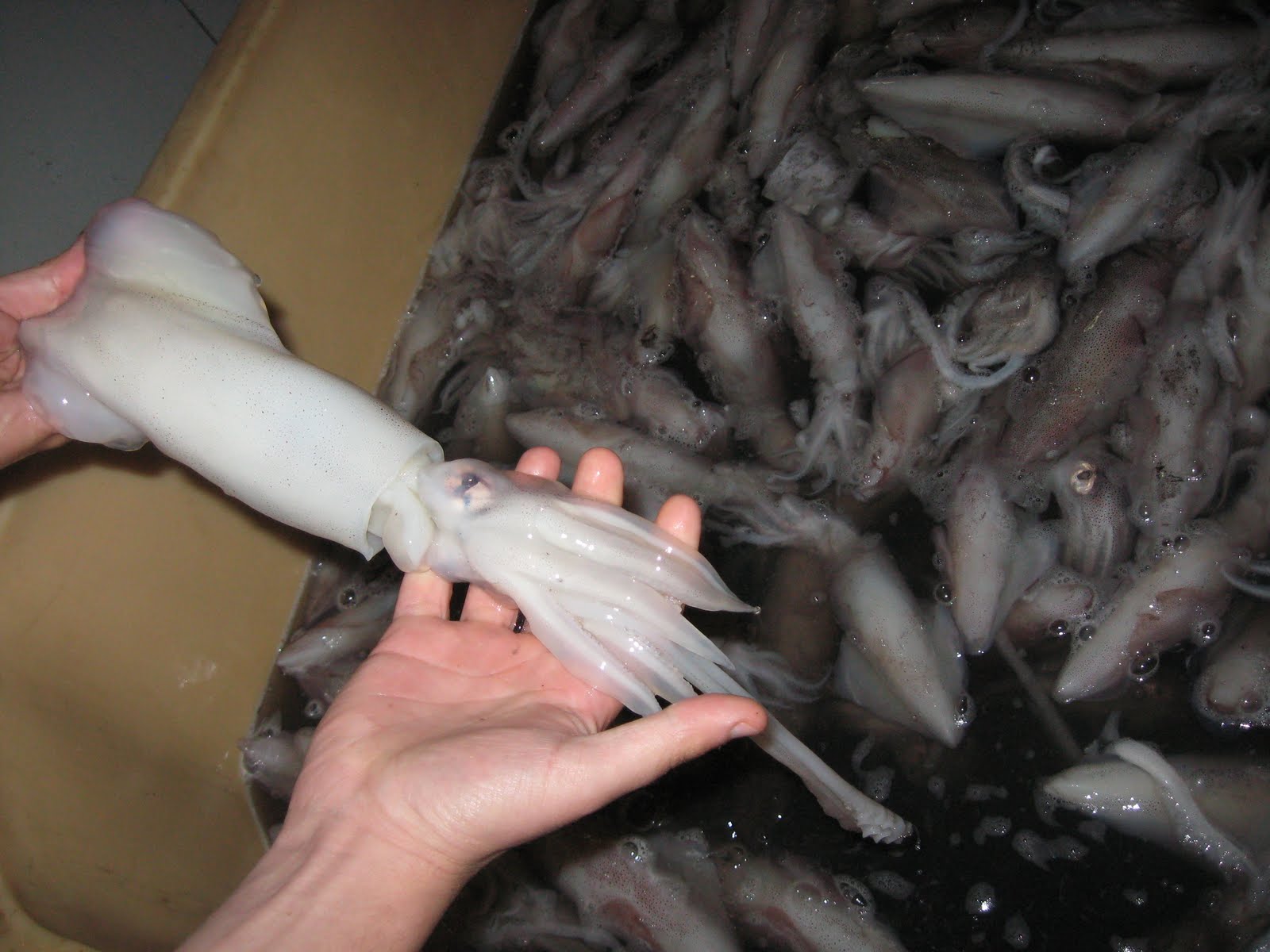
Squid


Saturday, April 9, 2011

Fish Farm Tour of Ireland- April 2011

After the Aquaculture Insurance Conference in Kinsale, Ireland, I spent several days touring fish farms in the south-west region of the country.  My father had flown out from Los Angeles to attend the Conference, so I joined him and several other delegates on these tours.  The entire trip was organized by Geoff Robinson, an Aquaculture Development Coordinator for the Irish Sea Fisheries Board (Board Ischa Maera).

We began at a sea urchin recirculation facility in Bantry Bay, where the farmers are growing urchins to sell their roe in French and Asian markets.  The roe, called 'uni' in sushi restaurants, is a highly-prized delicacy in certain countries, and the farmer was kind enough to allow us a small taste of urchins fresh from his tanks.  After that, we traveled by boat to a longline site, where a farmer was growing urchins and scallops: on this short visit we spoke about the life cycles and different production systems of these species.

Juvenile urchins
The orange masses are the roe, sold as 'uni' in sushi restaurants
A scallop farmer checks on his stock 


The next day we visited a recirculation system for abalone, a very valuable gastropod that resembles a large snail.  These animals can sell for up to 100 dollars per kilo, making their farming a potentially very profitable business.  The farmer had carefully planned the operation, from its design to its management, and overall the facility was very impressive.  After that, we drove to a salmon cage site (Murphy`s Irish Seafood), and while we did not have a chance to take the boat out to the cages, we spoke to the manager about the operation.  He informed us that the majority of salmon production in Ireland was organic and was marketed as such, allowing Irish salmon to be differentiated as a premium product in the marketplace.


The third day found us traveling from Bantry, where we had been staying for the past three nights, to Dublin, where we ended our tour.  Along the way, we stopped at a flow-through trout farm (Goatsbridge Premium Irish Trout), where rainbow trout were grown in earthen ponds.  This was a family-owned and -operated farm, with a hatchery, grow-out, and processing facilities on-site.  They had begun marketing hot-smoked trout fillets, which we tasted and found to be absolutely delicious.  They have experienced success with this product in the market, and plan to ramp up production to meet growing demand.
Goatsbridge Premium Irish Trout Farm- Thomastown, Ireland
All in all, the tour was a resounding success, as we had the opportunity to meet and speak with many different farmers operating many different production systems.  Additionally, these farmers will be the first ones that I contact with respect to my upcoming Master`s thesis project.    
Longlines used to grow urchins and scallops
The smoked trout was delicious!

12th Aquaculture Insurance and Risk Management Conference- Kinsale, Ireland

Kinsale, Ireland

Last week I had the incredible opportunity to attend the 12th Aquaculture Insurance and Risk Management Conference which took place on March 31 & April 1, 2011.  It was held in Kinsale, Ireland, a small town near Cork in the south-west region of the country.  With just under 100 people in attendance from 19 different countries, this Conference was the largest gathering of aquaculture insurance specialists anywhere in the world.

Over the 2-day event, a variety of presentations were given on different subjects relating to the field of aquaculture insurance.  These topics included sustainability in aquaculture, national overviews of the aquaculture industry of several countries, a review of aquatic diseases and their impacts, biosecurity, legal issues, and the future of the aquaculture insurance market.

As my upcoming Master’s thesis project deals directly with aquaculture insurance, I attended the Conference to learn about the industry, in addition to making contacts that may contribute their expertise to my study.  I feel as if I succeeded with both of these goals, as I learned a great deal and my project proposal was received with interest from many people.   

The Conference was organized by Paddy Secretan, who has been involved in aquaculture insurance for many years and is arguably the premier authority when it comes to this specialist field.  Paddy has been, and will continue to be, an invaluable resource for my thesis project, and he introduced me to many key people at the Conference.

Overall it was an incredible experience to meet and speak with so many experts in this field, and I am very excited to get many of them involved in my study when the work begins in a few short weeks.      

Advanced Module 6- Geographic Information Systems (GIS) and Remote Sensing

The sixth and final Advanced Module in the Stirling MSc program was titled Geographic Information Systems (GIS) and Remote Sensing and was taught by Lindsay Ross.  This course covered the basics of GIS modeling, and had small groups working on analysis projects utilizing these techniques.

The first two days consisted of lectures, with topics including GIS and remote sensing software, databases, and applications, as well as a history of the development of these techniques.  On the third day, we received tutorials of the software we would be using to complete our assessments: my group of three students was assigned a study of the suitability of sites for pond construction in the African nation of Ghana.  We adopted the perspective of National Environmental Regulators and, utilizing GIS, we analyzed the entire country for pond aquaculture suitability according to a variety of factors, including soil composition, livestock production, population density, water availability, etc.

By mapping these factors and deciding their relative importance to aquaculture, different maps could be overlaid on top of one another to give a comprehensive overview of the suitability of a given region.  We used recommendations from the FAO to determine the suitability of detailed factors such as soil type and relative distance from water bodies.

In the end, we produced a map that accurately displayed the suitability of sites for pond construction in Ghana.  These findings were then used to identify the best regions for pond aquaculture, as well as calculate potential production figures from these regions.  This study would be useful for potential developers and other aquaculture stakeholders, and it taught us the value of such a project as an integral part of the planning and design stage of an aquaculture operation.   
Soil variation in Ghana- each colour represents a different soil type